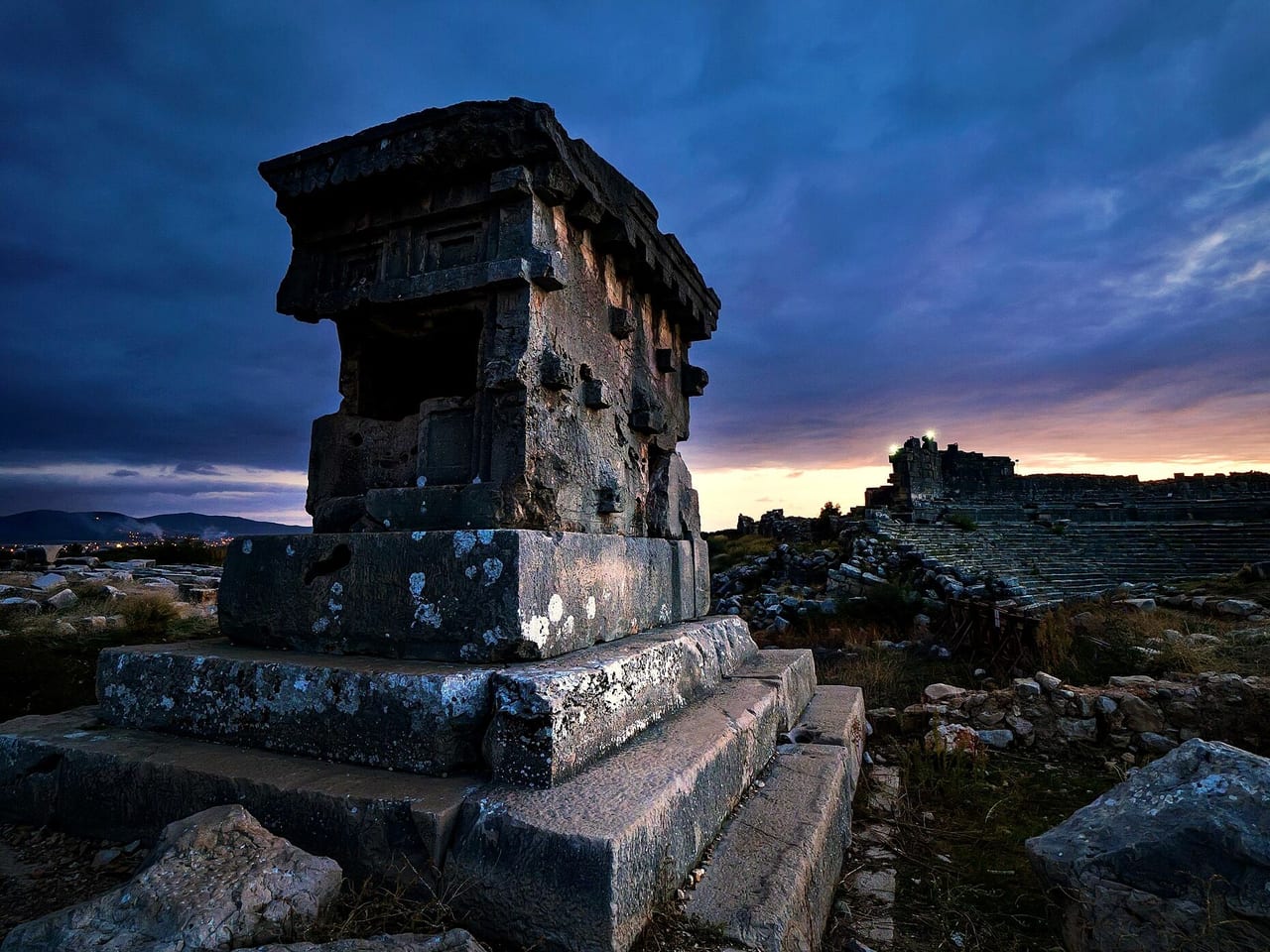
Xanthos
A Lycian city beside the Eşen River, on two hills overlooking the plain: a Roman theater, tombs on tall pedestals, and a pillar with a long Lycian inscription.
A city with two names
Xanthos is a Lycian city built on two hills overlooking the plain beside the Eşen River, at Kınık in the Kaş district. Its name in the Lycian language was Arnna; the name Xanthos means "yellow" in Greek, and the river too was called the Xanthos in antiquity. Homer tells how the Xanthians, led by Sarpedon, fought in the Trojan War, yet the finds go back no further than the 8th century BC. The city has two acropolises, the Lycian Acropolis and the Roman Acropolis, along with a Roman theater, an agora, and a colonnaded street, and it is best known for its monumental tombs.
Fires and new beginnings
When the Persian commander Harpagus arrived, the Xanthians resisted on the Xanthos Plain, then withdrew into the city and, rather than surrender, set their city on fire. Researchers give different years for this event: between 546 and 540 BC. Eighty families who were away from the city at the time survived, and the city came back to life; in the Persian period it soon recovered and minted coins. Between 475 and 450 BC the city suffered another great fire, and excavations show a thick layer of ash. Kuprlli, Kheriga, and Arbinas are names remembered from its local dynasty. Xanthos fell to Alexander the Great in 334 BC and came under the Ptolemies from 309 BC, then under Antiochus the Third. It was a leading city of Lycia; some researchers place the administrative center of the Lycian League in the 2nd century BC at Xanthos, while others place it at Patara.
From Rome to today
In 42 BC the Roman Brutus destroyed the city; Mark Antony repaired it, building went on under Vespasian, and most of its Roman buildings date from that period. A bishopric in the Byzantine era, the city lost its importance after the Arab raids of the 7th century. Charles Fellows studied the site in 1838; in the following years the reliefs of the Harpy Tomb, the Nereid Monument, the panels of the Lion Tomb, and other works were moved to England, and they are displayed in the British Museum. French excavations began in 1950 with Pierre Demargne. Letoon, 4 km away and within the borders of Muğla, was the religious center of Lycia and is known for its trilingual inscription. Together with Letoon, Xanthos was inscribed on the UNESCO World Heritage List in 1988.
Practical information
- Getting there: By Kaş–Fethiye buses. 46 km from Fethiye. Address: Kınık Mahallesi, Fethiye Karayolu, Kaş.
- Facilities: parking, restrooms, café, shop.
- Hours: Check official sources before you go.
- Admission: Check official sources before you go.
- Suggested time: 1.5 hours.
- Status: open.
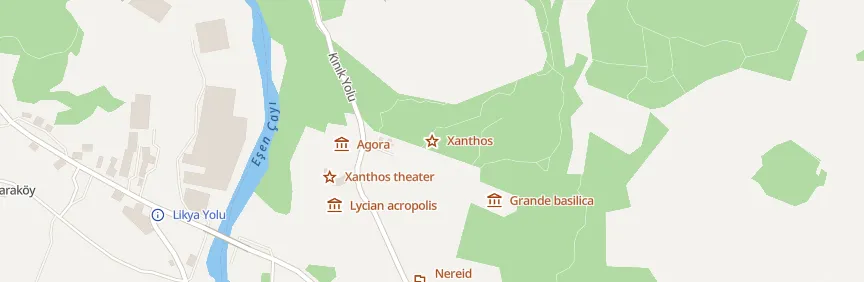
Where
Inside this place
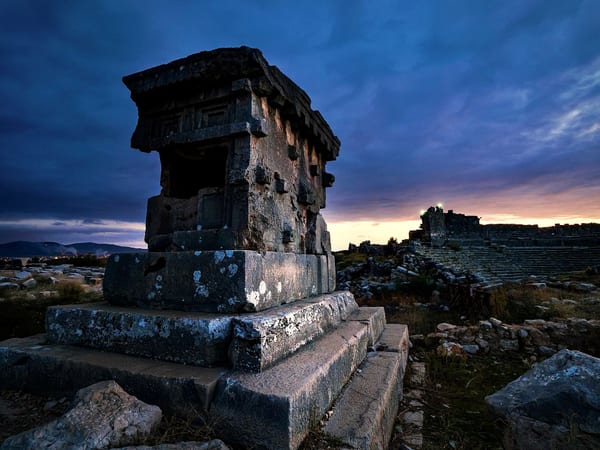 Hellenistic Gate (South Gate)Historical PlaceArch of VespasianHistorical PlaceNereid MonumentHistorical PlaceTheaterHistorical PlaceTower Tomb Above the TheaterHistorical PlaceRoman Tower TombHistorical PlacePillar Tomb with SarcophagusHistorical PlaceHarpy TombHistorical PlaceRoman AgoraHistorical PlaceInscribed PillarHistorical PlaceHouse-Type Tomb (East of the Agora)Historical PlaceLycian AcropolisHistorical PlaceColonnaded StreetHistorical PlaceDipylon (Double-Passage Arch)Historical PlaceEast Basilica (Cathedral)Historical PlaceDancers' SarcophagusHistorical Place
Nearby places
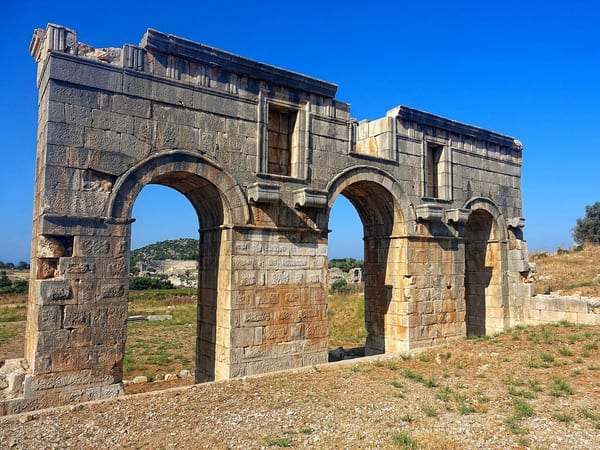 Agora

Listen as you walk
Guide & Travel starts the story by itself when you reach the place, and it works offline too.
Photos (20)
- Hellenistic Gate (South Gate) — Photo: Buğra Kaan Ersoy · CC BY-SA 4.0 · Wikimedia Commons (cropped)
- Arch of Vespasian — Photo: Buğra Kaan Ersoy · CC BY-SA 4.0 · Wikimedia Commons (cropped)
- Nereid Monument — Photo: Buğra Kaan Ersoy · CC BY-SA 4.0 · Wikimedia Commons (cropped)
- Theater — Photo: Buğra Kaan Ersoy · CC BY-SA 4.0 · Wikimedia Commons (cropped)
- Tower Tomb Above the Theater — Photo: Buğra Kaan Ersoy · CC BY-SA 4.0 · Wikimedia Commons (cropped)
- Roman Tower Tomb — Photo: Buğra Kaan Ersoy · CC BY-SA 4.0 · Wikimedia Commons (cropped)
- Pillar Tomb with Sarcophagus — Photo: Buğra Kaan Ersoy · CC BY-SA 4.0 · Wikimedia Commons (cropped)
- Harpy Tomb — Photo: Buğra Kaan Ersoy · CC BY-SA 4.0 · Wikimedia Commons (cropped)
- Roman Agora — Photo: Buğra Kaan Ersoy · CC BY-SA 4.0 · Wikimedia Commons (cropped)
- Inscribed Pillar — Photo: Buğra Kaan Ersoy · CC BY-SA 4.0 · Wikimedia Commons (cropped)
- House-Type Tomb (East of the Agora) — Photo: Buğra Kaan Ersoy · CC BY-SA 4.0 · Wikimedia Commons (cropped)
- Lycian Acropolis — Photo: Buğra Kaan Ersoy · CC BY-SA 4.0 · Wikimedia Commons (cropped)
- Colonnaded Street — Photo: Buğra Kaan Ersoy · CC BY-SA 4.0 · Wikimedia Commons (cropped)
- Dipylon (Double-Passage Arch) — Photo: Buğra Kaan Ersoy · CC BY-SA 4.0 · Wikimedia Commons (cropped)
- East Basilica (Cathedral) — Photo: Buğra Kaan Ersoy · CC BY-SA 4.0 · Wikimedia Commons (cropped)
- Dancers' Sarcophagus — Photo: Buğra Kaan Ersoy · CC BY-SA 4.0 · Wikimedia Commons (cropped)
- Agora — Photo: Bjørn Christian Tørrissen · CC BY-SA 4.0 · Wikimedia Commons (cropped)
- Tomb of Markia — Photo: Bjørn Christian Tørrissen · CC BY-SA 4.0 · Wikimedia Commons (cropped)
- Tomb Church — Photo: Bjørn Christian Tørrissen · CC BY-SA 4.0 · Wikimedia Commons (cropped)
- Bath of Nero — Photo: Bjørn Christian Tørrissen · CC BY-SA 4.0 · Wikimedia Commons (cropped)
