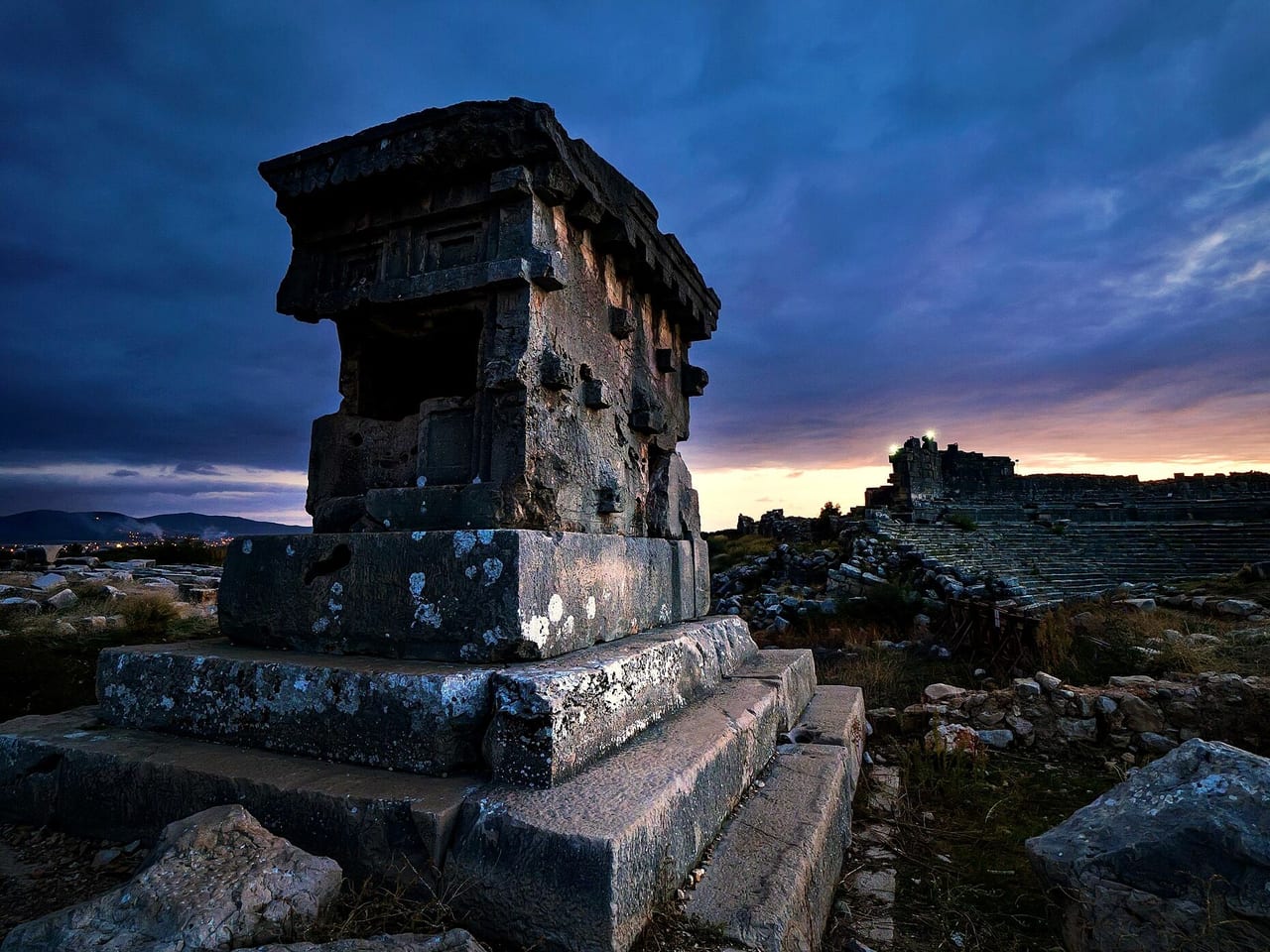
Inscribed Pillar
A pillar tomb about eleven meters high at the agora's northeast corner: Lycian on four sides, Greek verses on the north, and an owner whose name is missing and still debated.
Three texts on one stone
The Inscribed Pillar, at the northeast corner of the agora, is a pillar tomb about 11 m high. Above the inscribed base was a burial chamber, and above that a statue of a ruler on a lion throne; the statue is no longer in place. The stone carries three texts: a Greek epigram, a long Lycian text, and a second, short Lycian text. The Lycian runs across four sides, and 12 lines of Greek occupy the north side. The Lycian text is not fully understood, and clues come from its names. It is also argued that the monument was the work of more than one hand and not a single design.
Its owner and his victories
The owner's name is missing from the stone. For a long time he was taken to be Kherei; today many researchers propose Kheriga, son of Harpagus, known in Greek as Gergis. This Harpagus should not be confused with the Persian commander. Researchers date the monument between the late 5th and early 4th centuries BC. The epigram speaks of many victory monuments raised to Zeus and boasts of prowess in war; the inscription also mentions Gergis and his son Arbinas. The burial chamber's reliefs of victory, shields, and war are in the British Museum and the Istanbul Archaeological Museums. Thucydides writes that an Athenian named Melesander came with six ships, was defeated, and died; a link with the Athenian war mentioned on the pillar is considered.
Where
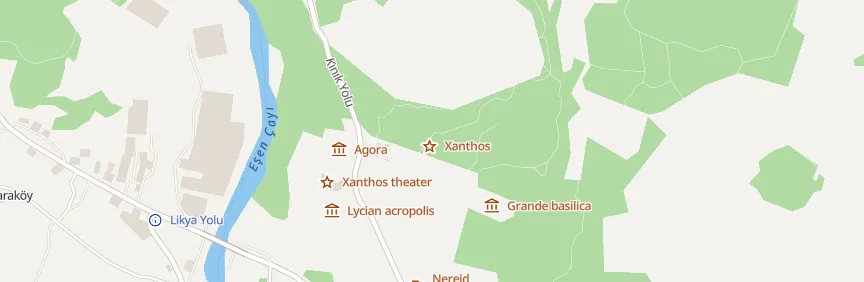
Nearby places
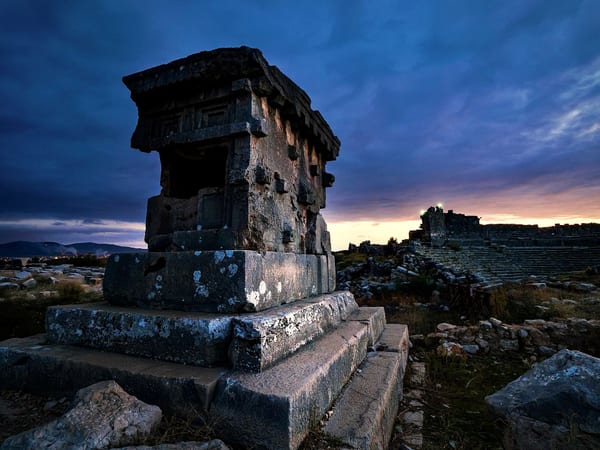 Arch of Vespasian

Listen as you walk
Guide & Travel starts the story by itself when you reach the place, and it works offline too.
Photos (4)
- Arch of Vespasian — Photo: Buğra Kaan Ersoy · CC BY-SA 4.0 · Wikimedia Commons (cropped)
- Hellenistic Gate (South Gate) — Photo: Buğra Kaan Ersoy · CC BY-SA 4.0 · Wikimedia Commons (cropped)
- House-Type Tomb (East of the Agora) — Photo: Buğra Kaan Ersoy · CC BY-SA 4.0 · Wikimedia Commons (cropped)
- Theater — Photo: Buğra Kaan Ersoy · CC BY-SA 4.0 · Wikimedia Commons (cropped)