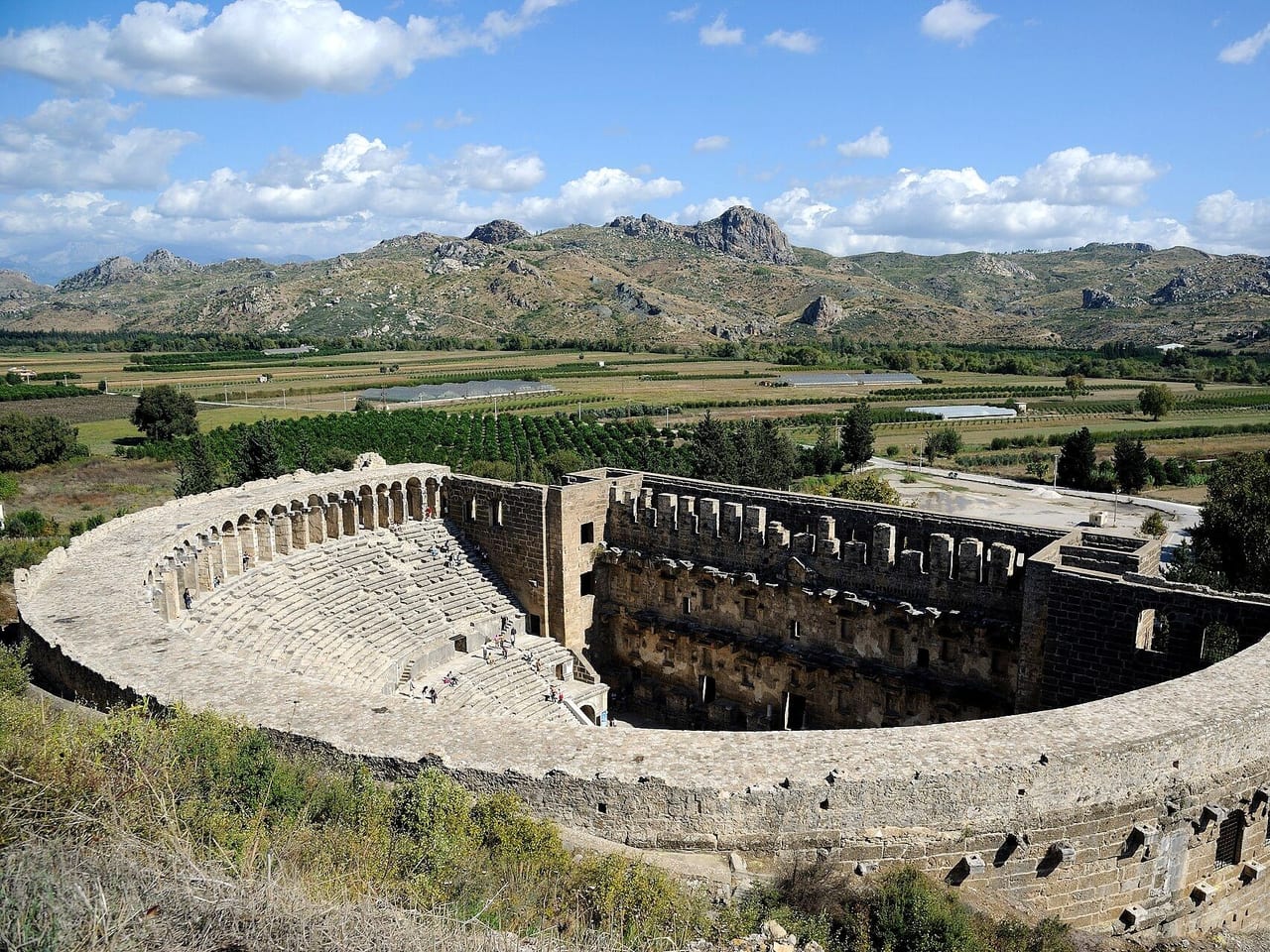
Aspendos
A Pamphylian city built on a hill and at its foot near the Köprüçay: a Roman theater on the plain, an ancient street climbing the hill, an agora and public buildings on top, and an aqueduct to the north.
Hill and plain
Aspendos is a Pamphylian city in the Serik district, built on and around a hill near the Köprüçay River, the ancient Eurymedon. The city has two parts: the lower city on the plain, where the theater stands, and the upper city on the hill, where the agora and the public buildings were gathered. To the north runs the aqueduct that brought water from the mountains into the city.
A city of trade
Aspendos was a wealthy trading city that struck its own silver coins. Salt taken from a nearby lake, horses bred here, olive oil, grain, and wine were its main goods. The city surrendered to Alexander the Great in 333 BC and after his death came under Ptolemaic rule. It saw its most brilliant period under the Roman Empire, and most of the large buildings seen today date from that time. Settlement continued through the Byzantine and Seljuk periods, and the Seljuks used the theater as a palace. The ruins were first studied in detail in 1884 by an expedition led by Lanckoroński. In 2015 the theater and the aqueduct were added to UNESCO's World Heritage Tentative List.
The layout of the city
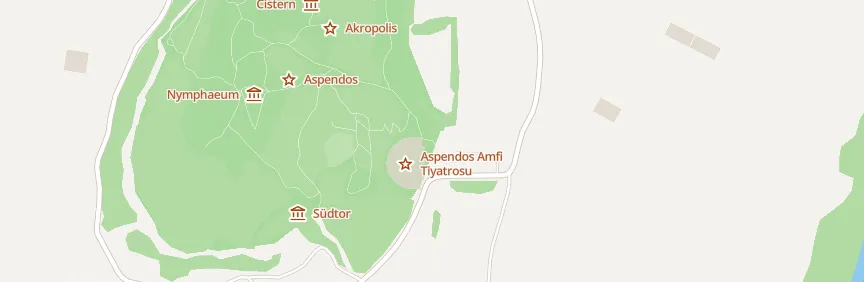
On the plain, a stadium lies north of the theater and two large buildings thought to be baths lie to its south. Theater Street starts at the theater, passes the eastern cemetery and the East City Gate, and reaches the East Square, with a mosaic building on its east side and a monumental gate on its west. It then runs past a bakery and terrace houses, through the valley between the basilica and the hilltop temple, and enters the forum through a second monumental gate. On the hill, the council house, monumental fountain, Roman basilica, two-story shops, and a Roman villa surround the agora; the south gate and rock-cut cisterns lie along the hill's edges.
Practical information
- Getting there: about 50 km from Antalya; minibuses (dolmuş) run from Serik.
- Hours and fees: for current hours and fees, check the official website before you go.
- Suggested time: 2 hours (including the aqueduct).
- Status: open.
[bilgi: Excavations are ongoing in the upper city; excavation areas may be closed to visitors.]
Where
Inside this place
 TheaterHistorical PlaceTheater StreetHistorical PlaceEast NecropolisHistorical PlaceEast City GateHistorical PlaceEast Square and Monumental GateHistorical PlaceBakeryHistorical PlaceSouth Terrace HousesHistorical PlaceTempleHistorical PlaceMonumental GateHistorical PlaceForumHistorical PlaceBouleuterionHistorical PlaceMonumental FountainHistorical PlaceAgoraHistorical PlaceRoman State BasilicaHistorical PlaceTwo-Story ShopsHistorical PlaceRoman VillaHistorical PlaceAqueductHistorical Place
Nearby places
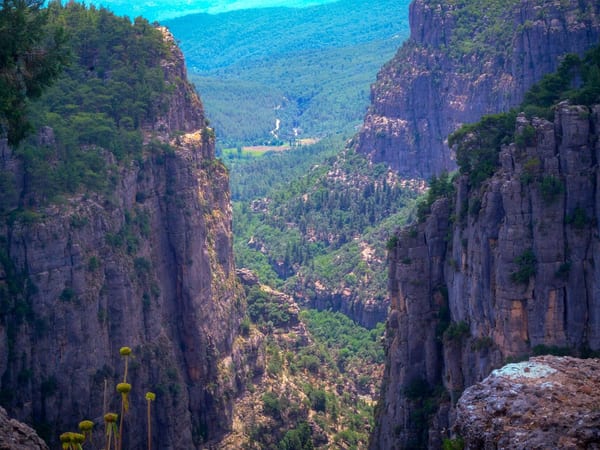 Tazı Canyon
 The Arch

Routes that include this place
Listen as you walk
Guide & Travel starts the story by itself when you reach the place, and it works offline too.
Photos (22)
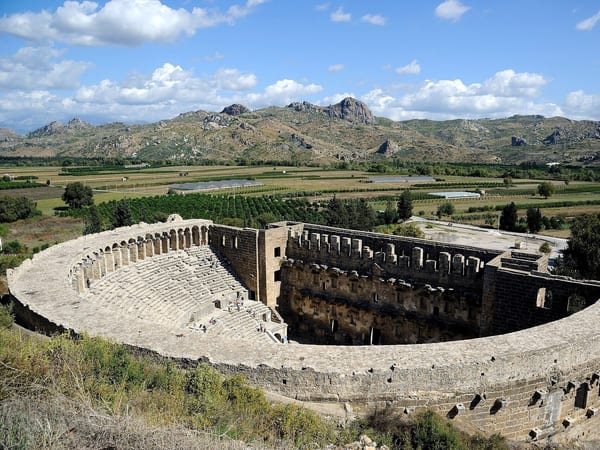
- Theater — Photo: Saffron Blaze · CC BY-SA 3.0 · Wikimedia Commons (cropped)
- Theater Street — Photo: Saffron Blaze · CC BY-SA 3.0 · Wikimedia Commons (cropped)
- East Necropolis — Photo: Saffron Blaze · CC BY-SA 3.0 · Wikimedia Commons (cropped)
- East City Gate — Photo: Saffron Blaze · CC BY-SA 3.0 · Wikimedia Commons (cropped)
- East Square and Monumental Gate — Photo: Saffron Blaze · CC BY-SA 3.0 · Wikimedia Commons (cropped)
- Bakery — Photo: Saffron Blaze · CC BY-SA 3.0 · Wikimedia Commons (cropped)
- South Terrace Houses — Photo: Saffron Blaze · CC BY-SA 3.0 · Wikimedia Commons (cropped)
- Temple — Photo: Saffron Blaze · CC BY-SA 3.0 · Wikimedia Commons (cropped)
- Monumental Gate — Photo: Saffron Blaze · CC BY-SA 3.0 · Wikimedia Commons (cropped)
- Forum — Photo: Saffron Blaze · CC BY-SA 3.0 · Wikimedia Commons (cropped)
- Bouleuterion — Photo: Saffron Blaze · CC BY-SA 3.0 · Wikimedia Commons (cropped)
- Monumental Fountain — Photo: Saffron Blaze · CC BY-SA 3.0 · Wikimedia Commons (cropped)
- Agora — Photo: Saffron Blaze · CC BY-SA 3.0 · Wikimedia Commons (cropped)
- Roman State Basilica — Photo: Saffron Blaze · CC BY-SA 3.0 · Wikimedia Commons (cropped)
- Two-Story Shops — Photo: Saffron Blaze · CC BY-SA 3.0 · Wikimedia Commons (cropped)
- Roman Villa — Photo: Saffron Blaze · CC BY-SA 3.0 · Wikimedia Commons (cropped)
- Aqueduct — Photo: Saffron Blaze · CC BY-SA 3.0 · Wikimedia Commons (cropped)
- Tazı Canyon — Photo: Fatih Demir · CC BY-SA 4.0 · Wikimedia Commons (cropped)
- The Arch — Photo: Dosseman · CC BY-SA 4.0 · Wikimedia Commons (cropped)
- Monument of Vespasian — Photo: Dosseman · CC BY-SA 4.0 · Wikimedia Commons (cropped)
- Harbor Baths — Photo: Dosseman · CC BY-SA 4.0 · Wikimedia Commons (cropped)
- Perge — Photo: Mehmety11maz · CC BY-SA 4.0 · Wikimedia Commons (colour corrected)


