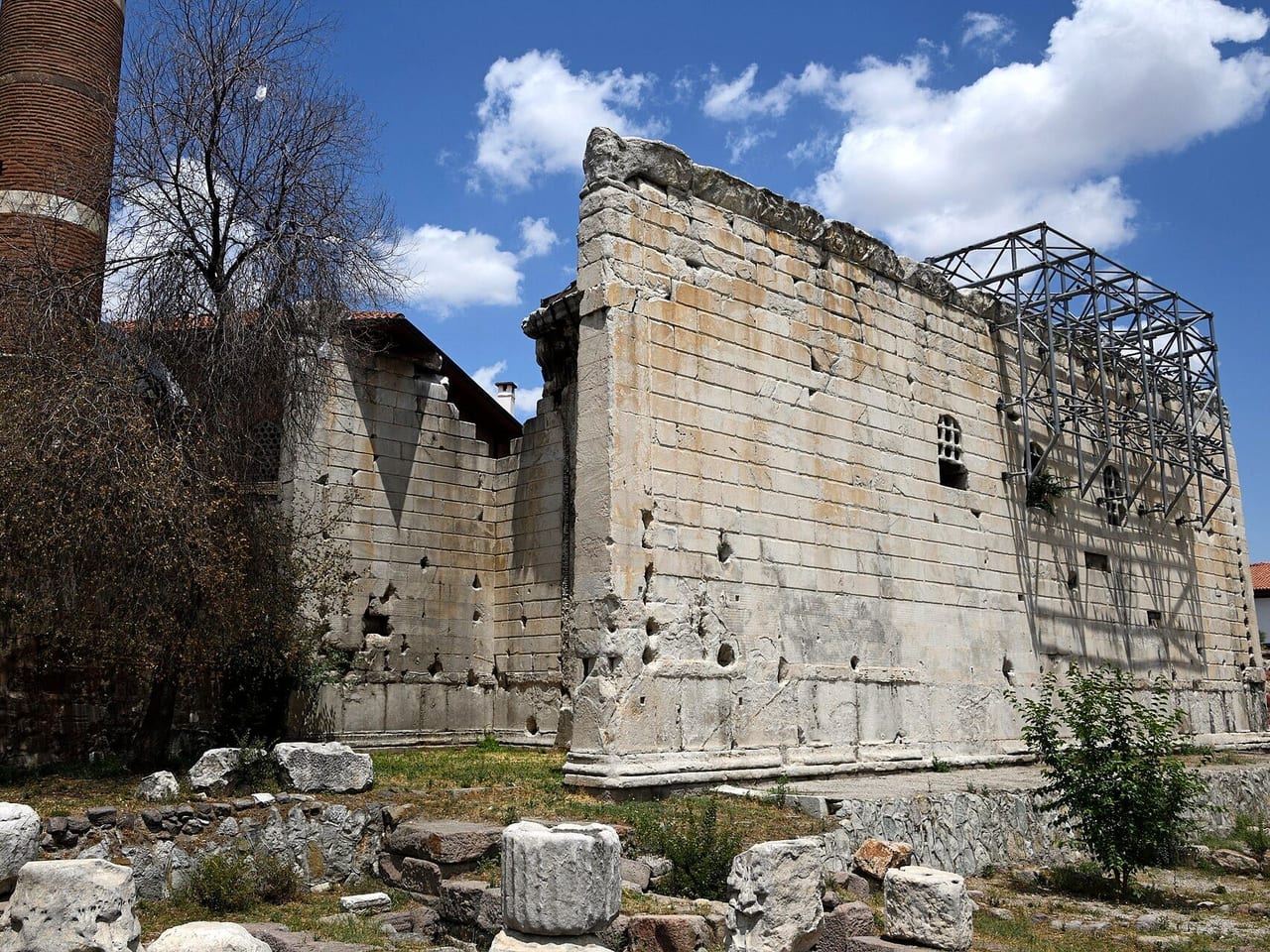
Temple of Augustus
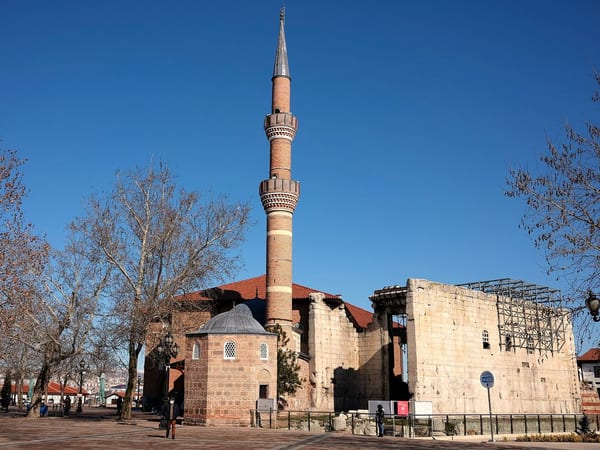
Next to Hacı Bayram Mosque, the Roman temple dedicated to Augustus and the goddess Roma, whose walls carry the most complete copy of the Res Gestae, the emperor's own account of his deeds.
A temple for the emperor
Galatia joined Rome under Emperor Augustus, and Ankyra became the center of the new province. The temple, one of the city's most important Roman buildings, was dedicated to Augustus and the goddess Roma; it was built by Pylaimenes, son of Amyntas. Some researchers date it to 25 BC, others to the start of the reign of Tiberius. It stands in the Corinthian order on a podium about 2 m high, with a pseudo-dipteral plan measuring 36 by 54.82 m: there were 8 columns on the short sides and 15 on the long sides. Its door is 8.40 m high. The wall blocks were laid without mortar and joined with iron clamps fixed in lead. In the Byzantine period the temple became a church (researchers give different dates, between the 4th and 6th centuries): the floor of the inner hall was lowered and three windows were opened in the southeast wall. In Ottoman times it served as a madrasa called Ak Medrese; Dernschwam, who came to Ankara in 1554, saw ten cells inside. In 1834 a sheikh had one of the walls partly pulled down to build a bath. Hacı Bayram Mosque adjoins the temple's northwest corner.
The Queen of Inscriptions
The temple's fame comes from the inscription on its walls: the Res Gestae Divi Augusti, the account of the emperor's deeds, one of four documents Augustus left with the Vestal Virgins before his death. The original text was on bronze tablets in Rome and has been lost. In Ankara the text is written in two languages, in letters once painted red: the Latin on the side walls of the entrance, the Greek on the outer wall of the inner hall. In the mid-16th century the embassy of Busbecq copied the text; Mommsen published its transcription in 1865 and called it the "Queen of Inscriptions"; Humann's team took a plaster cast in 1882. At the northwest end of the entrance there is also an inscription listing the priests.
Practical information
- Getting there: Ulus, Hacı Bayram quarter. For public transport, check the official websites of the transport authorities.
- Opening hours: the interior is closed to visitors for security reasons, while the temple can be seen from outside at any time; check the official website for the current situation.
- Admission: free to view from outside.
- Suggested time: 20 minutes.
- Status: viewable from outside.
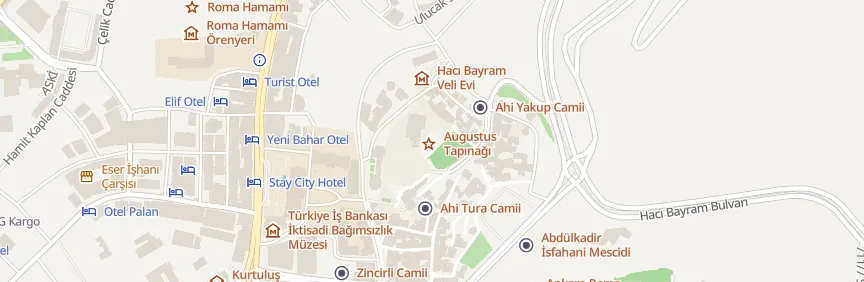
Where
Nearby places
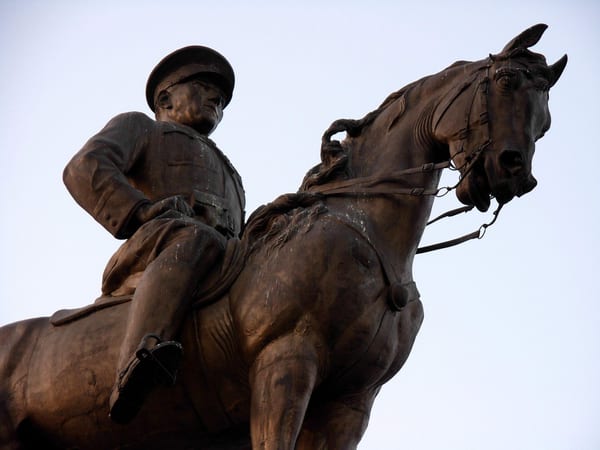 Ulus Square and Victory Monument
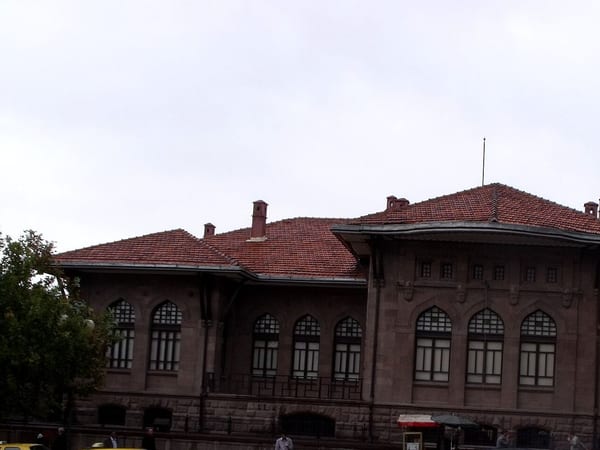 First Parliament Building
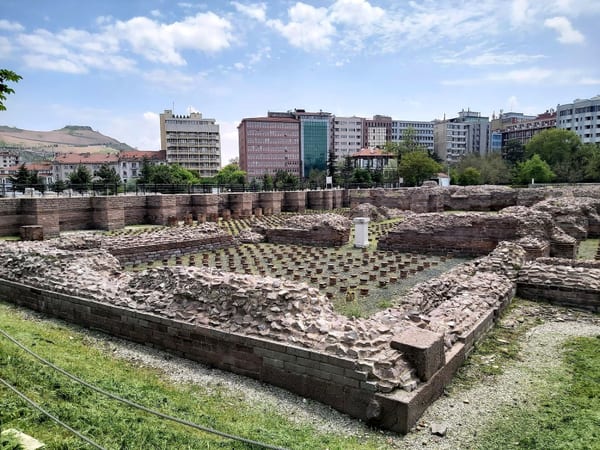 Roman Baths

Routes that include this place
Listen as you walk
Guide & Travel starts the story by itself when you reach the place, and it works offline too.
Photos (4)
- Hacı Bayram Mosque — Photo: Dursun Sülük · CC BY-SA 4.0 · Wikimedia Commons (cropped)
- Ulus Square and Victory Monument — Photo: brewbooks · CC BY-SA 2.0 · Wikimedia Commons (colour corrected)
- First Parliament Building — Photo: nurettingülay · CC BY-SA 3.0 · Wikimedia Commons (cropped)
- Roman Baths — Photo: 8kanarya1 · CC BY 4.0 · Wikimedia Commons (colour corrected)


