Selge
A Pisidian mountain city in the Taurus: a theater set against the rock, city walls, and the village of Altınkaya living among the ruins.
A Pisidian city in the Taurus
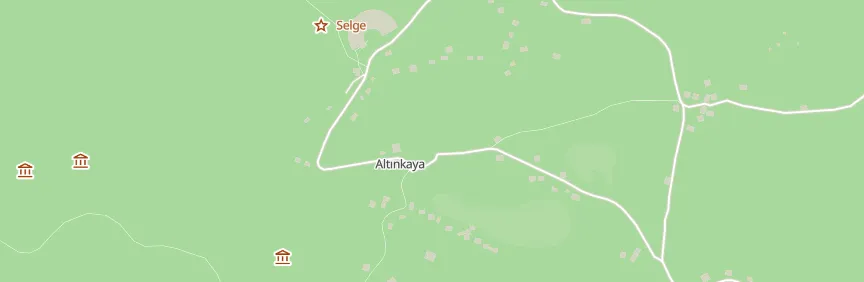
Selge lies on the southern slope of the Taurus, in the upper valley of the Köprüçay, within Köprülü Canyon National Park. Figures of about 950, about 1,000, and 1,250 meters are given for its elevation. Its ruins spread over three hills and are intertwined with the houses of the Altınkaya (Zerk) neighborhood of Manavgat; the settlement took the name Altınkaya in the 1970s. One of the important mountain cities of Pisidia, Selge was later included within the borders of Pamphylia. Olive oil, wine, medicinal and aromatic plants, and timber supported its economy, and part of the timber was probably floated down the Köprüçay to the coast. The old stone-walled terraces around it cover about 350 hectares.
From its founding to the Turkish period
Its founding is debated: some researchers trace it to the Dorian migrations at the end of the 2nd millennium BC, while others trace it to the 5th century BC. In the ancient story its founder is Calchas, and the city is also said to have been a colony of Lacedaemon. Even so, Anatolian personal names and two inscriptions thought to be in the Pisidian language show that local culture lived on into the Roman period. Selge appeared in history in the 5th century BC. It saw Lydian and Roman rule; some researchers think it also came under Persian rule, while others think it did not. It established friendly ties with Alexander the Great; an envoy from Selge met Alexander while he was besieging Termessos and turned him toward Sagalassos. In 218 BC the people of Selge besieged Pednelissos, were defeated by Garsyeris, the commander of Achaeus, and paid an indemnity. The city is said to have been able to field 20,000 fighting men. Christianized in the Byzantine period, Selge became the seat of a bishop; it came under Turkish rule in the 13th century and lived on as a settlement called Zerk. August Schönborn brought it back to notice in 1842.
The main sanctuary shown on its coins belonged to Zeus and Heracles: a platform reached by two stairways, an altar in front, and two strange trunks at its sides. The trunks were long taken for storax; today they are identified as lightning-struck cypress or juniper.
The ruins
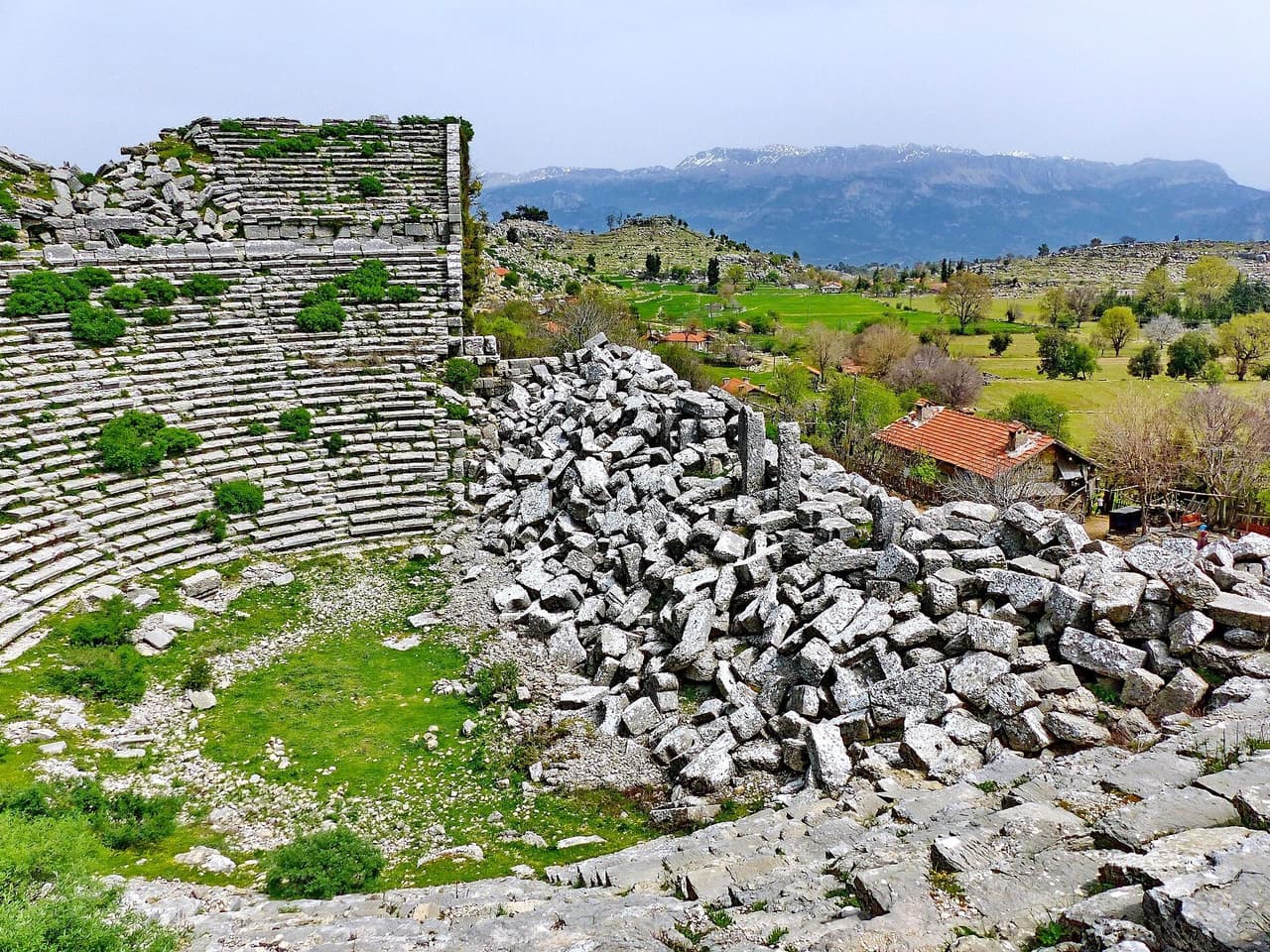
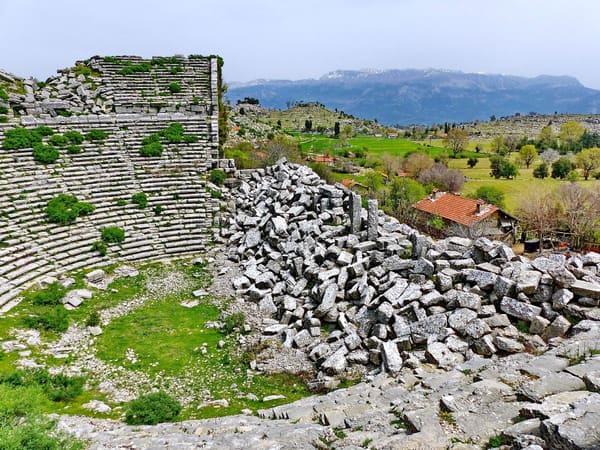
Its best-preserved building is the theater, set against the rock and repaired in the 3rd century AD. To the west stands an Ionic temple whose ceiling is decorated with an eagle motif; the ruins date mostly from the Roman period. City walls, a stadium, a gymnasium, agoras, a colonnaded street, a bath, cisterns, basilicas, temples of Zeus and Artemis, a necropolis, and an aqueduct are also among the ruins.
Practical information
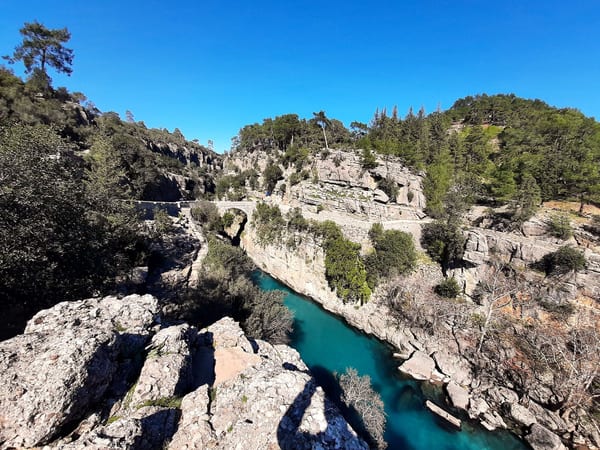
- Getting there: By the road that crosses the Oluk Bridge in Köprülü Canyon; about 13 km beyond the bridge.
- Opening hours and admission: Check official sources before you go.
Where
Inside this place
 City Walls
Nearby places
 Köprülü Canyon
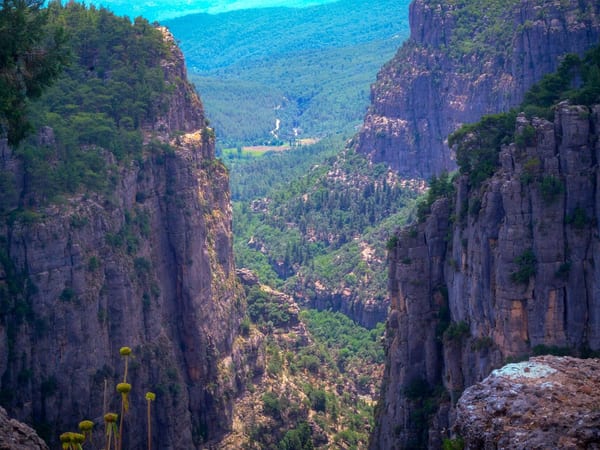 Tazı Canyon
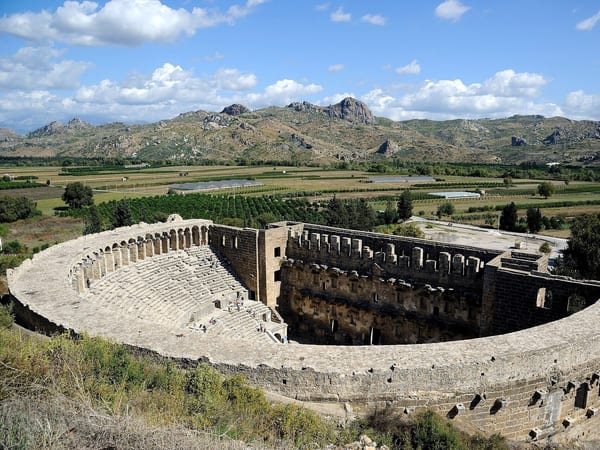 Aqueduct

Listen as you walk
Guide & Travel starts the story by itself when you reach the place, and it works offline too.
Photos (7)
- City Walls — Photo: Volker Höhfeld · CC BY-SA 4.0 · Wikimedia Commons (cropped)
- Theater — Photo: Volker Höhfeld · CC BY-SA 4.0 · Wikimedia Commons (cropped)
- Stadium — Photo: Volker Höhfeld · CC BY-SA 4.0 · Wikimedia Commons (cropped)
- Köprülü Canyon — Photo: Gokhan aktas 07 · CC BY-SA 4.0 · Wikimedia Commons (cropped)
- Tazı Canyon — Photo: Fatih Demir · CC BY-SA 4.0 · Wikimedia Commons (cropped)
- Aqueduct — Photo: Saffron Blaze · CC BY-SA 3.0 · Wikimedia Commons (cropped)
- Bouleuterion — Photo: Saffron Blaze · CC BY-SA 3.0 · Wikimedia Commons (cropped)


