City Walls

Hellenistic walls that enclose the lower city in a rough rectangle, strengthened by square towers that project outward; at the end of the Roman age they were extended to the south and west.
A belt of stone around the plain
Together with the southern gate and its round towers, the walls are the earliest remains of the lower city. Starting from the eastern and western slopes of the acropolis hill, they run down to the south and enclose the city in a rough rectangle, following the shortest possible line. They were built in the Hellenistic period; for their exact date, some researchers propose the 3rd century BC, while others suggest around 188 BC or the early 1st century BC. They were clearly laid out with a careful plan rather than in haste: an almost unbroken wall-walk ran along the top, and square towers projected entirely beyond the line of the wall. The towers were repaired many times over the centuries.
Gates and expansion
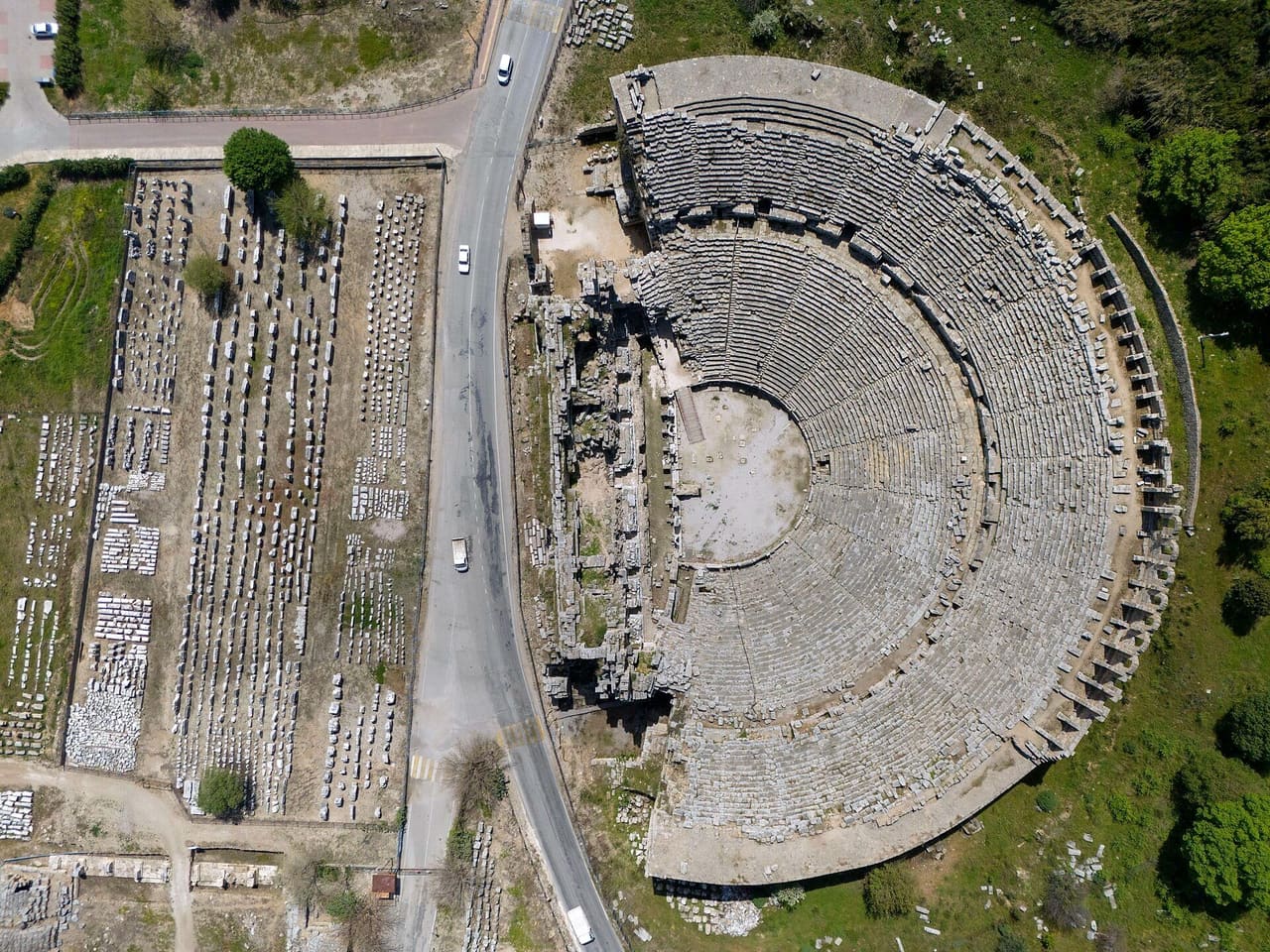
The city had gates to the west, east, and south; no trace of the east gate survives today. The theater and the stadium remained outside the walls. In the late Roman period the walls were extended to the south. To the west, too, the wall was pushed out to take in the North Baths. Today the walls still stand in places.
Where
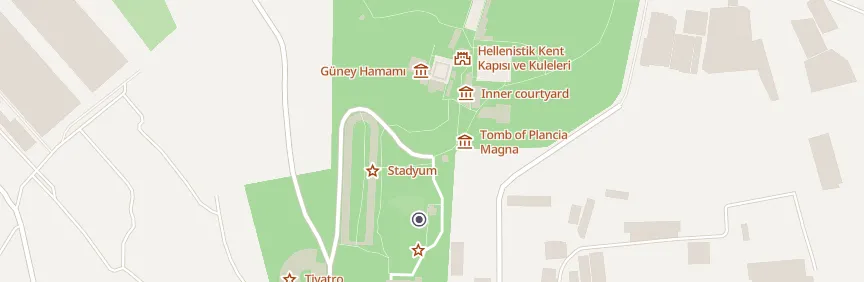
Nearby places
Routes that include this place
Listen as you walk
Guide & Travel starts the story by itself when you reach the place, and it works offline too.
Photos (5)
- Tomb of Plancia Magna — Photo: Mehmety11maz · CC BY-SA 4.0 · Wikimedia Commons (colour corrected)
- F4 Fountain — Photo: Mehmety11maz · CC BY-SA 4.0 · Wikimedia Commons (colour corrected)
- Roman Gate — Photo: Mehmety11maz · CC BY-SA 4.0 · Wikimedia Commons (colour corrected)
- Fountain of Septimius Severus — Photo: Mehmety11maz · CC BY-SA 4.0 · Wikimedia Commons (colour corrected)
- Perge — Photo: Mehmety11maz · CC BY-SA 4.0 · Wikimedia Commons (colour corrected)