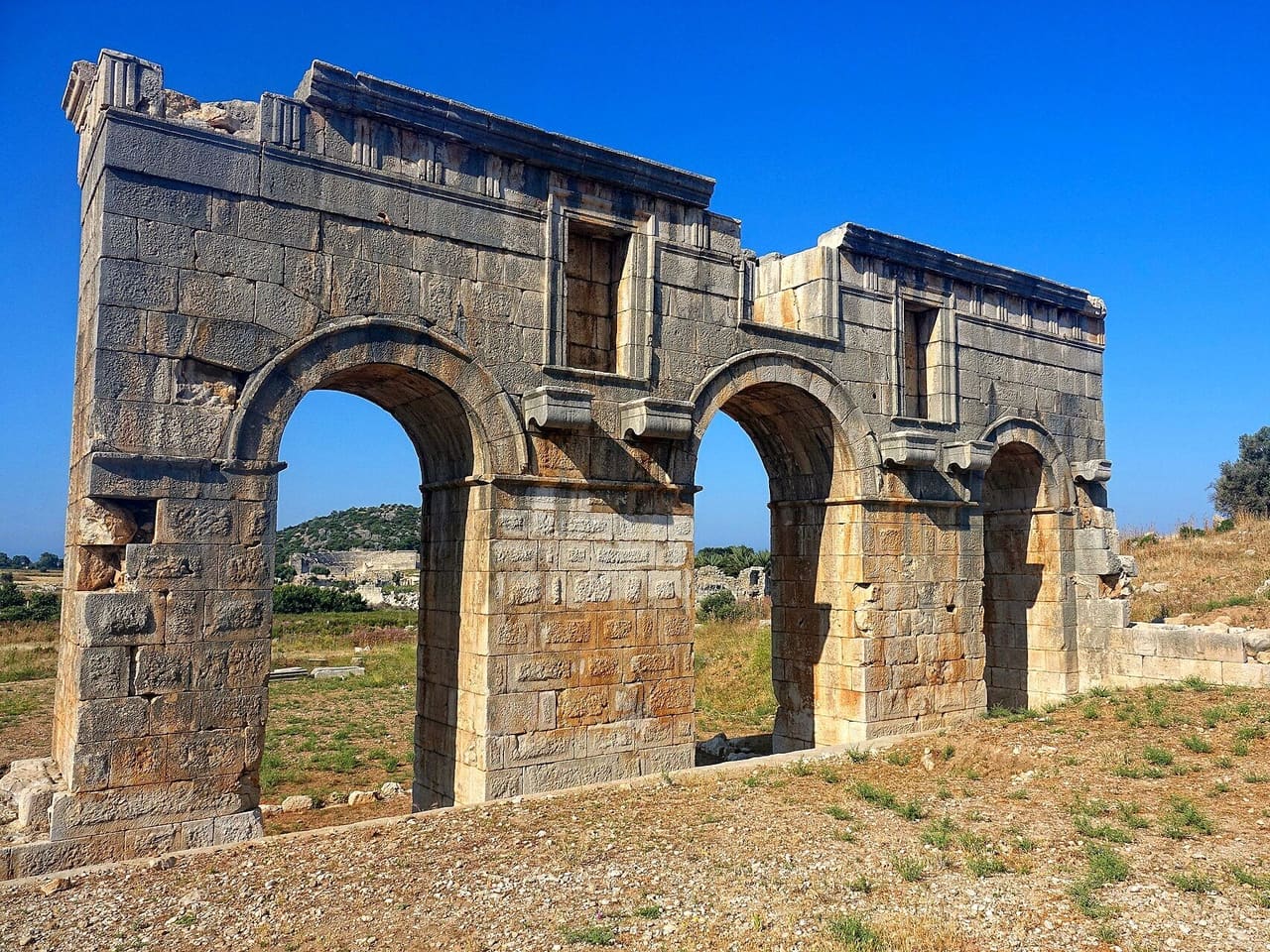
Patara
East of the Eşen River, a Lycian harbor city named in Hittite texts: assembly hall, theater, city gate, Nero-era lighthouse, and the long beach beside it.
The valley's door to the sea
Patara lies at Gelemiş in the Kaş district, east of the Eşen River, on the border between Antalya and Muğla. It was founded around a harbor bay at the southern end of the Xanthos Valley. Scholars give different dates for the first settlement; the earliest traces fall between the 6th and the 3rd millennium BC. Hittite texts of the 13th century BC, including the Yalburt inscription on the Lukka campaign of Tudhaliya IV, name a place called "Patar." Most scholars identify it with Patara; others are doubtful, because the inscription speaks of a "mountain." The city's Lycian name was Pttara.
Rulers and the league
Known for its oracle, the city was regarded as the birthplace of Apollo. It came under Persian rule around 540 BC and passed to Alexander the Great in 334/333 BC. From about 287 to 197 BC the Ptolemies held it; Ptolemy II renamed the city in honor of his wife Arsinoe, but the name did not last. During the Seleucid period, between 197 and 189 BC, Hannibal made Patara a base while commanding part of the Seleucid fleet. After the Peace of Apamea in 188/187 BC, Rhodes ruled the city. The seat of the Lycian League in 168/167 BC is disputed: some scholars favor Patara, others Xanthos. Livy calls the city "caput gentis," and Patara was one of the league's six cities with three votes.
From Rome to Cem Sultan
In AD 43 Claudius made Lycia a province with Patara as its capital, and Patara remained the capital of Lycia et Pamphylia, created in AD 73/74. The city was a naval base, a grain port, and a judicial center. St. Nicholas was born in Patara. According to the Acts of the Apostles, Paul came to Patara from Rhodes and boarded a ship bound for Phoenicia. The city was also a bishopric: its bishops Eudemus and Eudemus II are recorded at Nicaea in 325 and at Constantinople in 381. In the 10th century AD it was a Byzantine naval base; it fell within the Seljuk frontier in 1211 and passed to the Ottomans in 1424. The meeting of Cem Sultan with a Rhodian delegation in 1478 is its last important record. With the harbor silting up, the city lost its power. Patara is among the Lycian cities proposed for the UNESCO World Heritage Tentative List in 2009. The long Patara Beach stretches beside it.
Practical information
- Getting there: Gelemiş Mahallesi, Örenyeri Sokak No: 1, Kaş. Gelemiş can be reached by public transportation.
- Opening hours: Check local official sources before you go.
- Admission: Check local official sources before you go.
- Status: open.
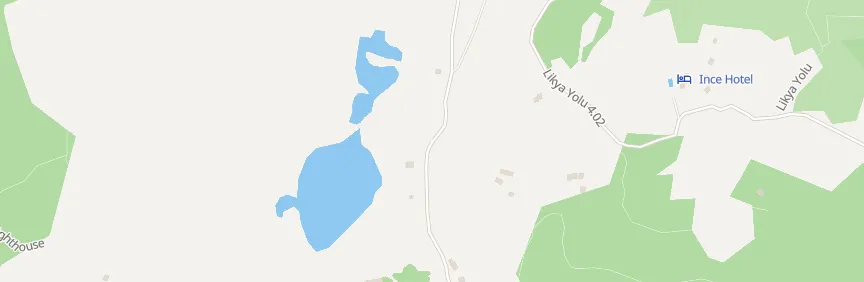
Where
Inside this place
 Tomb of MarkiaHistorical PlaceTomb ChurchHistorical PlaceTepecik NecropolisHistorical PlaceCity GateHistorical PlaceHarbor BathHistorical PlaceCity BasilicaHistorical PlaceCorinthian TempleHistorical PlaceHarbor StreetHistorical PlaceCentral BathHistorical PlaceBath of NeroHistorical PlaceAgoraHistorical PlaceSmall BathHistorical PlaceAssembly HallHistorical PlacePrytaneionHistorical PlaceTheaterHistorical PlaceAncient HarborHistorical PlacePatara BeachHistorical Place
Nearby places
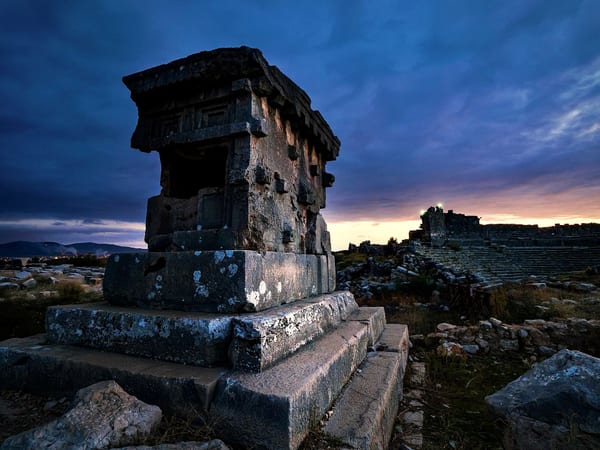 Nereid Monument

Listen as you walk
Guide & Travel starts the story by itself when you reach the place, and it works offline too.
Photos (21)
- Tomb of Markia — Photo: Bjørn Christian Tørrissen · CC BY-SA 4.0 · Wikimedia Commons (cropped)
- Tomb Church — Photo: Bjørn Christian Tørrissen · CC BY-SA 4.0 · Wikimedia Commons (cropped)
- Tepecik Necropolis — Photo: Bjørn Christian Tørrissen · CC BY-SA 4.0 · Wikimedia Commons (cropped)
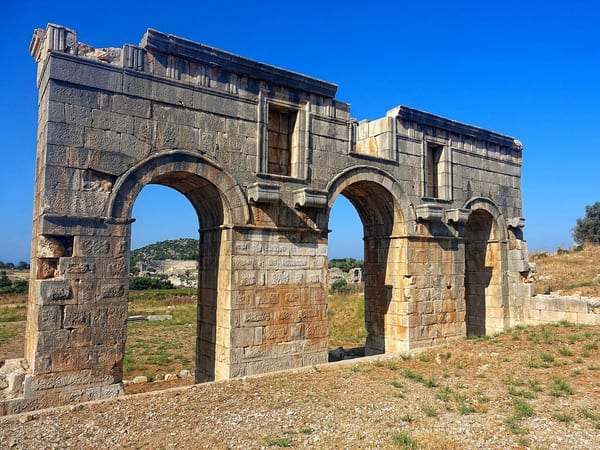
- City Gate — Photo: Bjørn Christian Tørrissen · CC BY-SA 4.0 · Wikimedia Commons (cropped)
- Harbor Bath — Photo: Bjørn Christian Tørrissen · CC BY-SA 4.0 · Wikimedia Commons (cropped)
- City Basilica — Photo: Bjørn Christian Tørrissen · CC BY-SA 4.0 · Wikimedia Commons (cropped)
- Corinthian Temple — Photo: Bjørn Christian Tørrissen · CC BY-SA 4.0 · Wikimedia Commons (cropped)
- Harbor Street — Photo: Bjørn Christian Tørrissen · CC BY-SA 4.0 · Wikimedia Commons (cropped)
- Central Bath — Photo: Bjørn Christian Tørrissen · CC BY-SA 4.0 · Wikimedia Commons (cropped)
- Bath of Nero — Photo: Bjørn Christian Tørrissen · CC BY-SA 4.0 · Wikimedia Commons (cropped)
- Agora — Photo: Bjørn Christian Tørrissen · CC BY-SA 4.0 · Wikimedia Commons (cropped)
- Small Bath — Photo: Bjørn Christian Tørrissen · CC BY-SA 4.0 · Wikimedia Commons (cropped)
- Assembly Hall — Photo: Bjørn Christian Tørrissen · CC BY-SA 4.0 · Wikimedia Commons (cropped)
- Prytaneion — Photo: Bjørn Christian Tørrissen · CC BY-SA 4.0 · Wikimedia Commons (cropped)
- Theater — Photo: Bjørn Christian Tørrissen · CC BY-SA 4.0 · Wikimedia Commons (cropped)
- Ancient Harbor — Photo: Bjørn Christian Tørrissen · CC BY-SA 4.0 · Wikimedia Commons (cropped)
- Patara Beach — Photo: Bjørn Christian Tørrissen · CC BY-SA 4.0 · Wikimedia Commons (cropped)
- Nereid Monument — Photo: Buğra Kaan Ersoy · CC BY-SA 4.0 · Wikimedia Commons (cropped)
- Dipylon (Double-Passage Arch) — Photo: Buğra Kaan Ersoy · CC BY-SA 4.0 · Wikimedia Commons (cropped)
- Colonnaded Street — Photo: Buğra Kaan Ersoy · CC BY-SA 4.0 · Wikimedia Commons (cropped)
- Roman Tower Tomb — Photo: Buğra Kaan Ersoy · CC BY-SA 4.0 · Wikimedia Commons (cropped)
