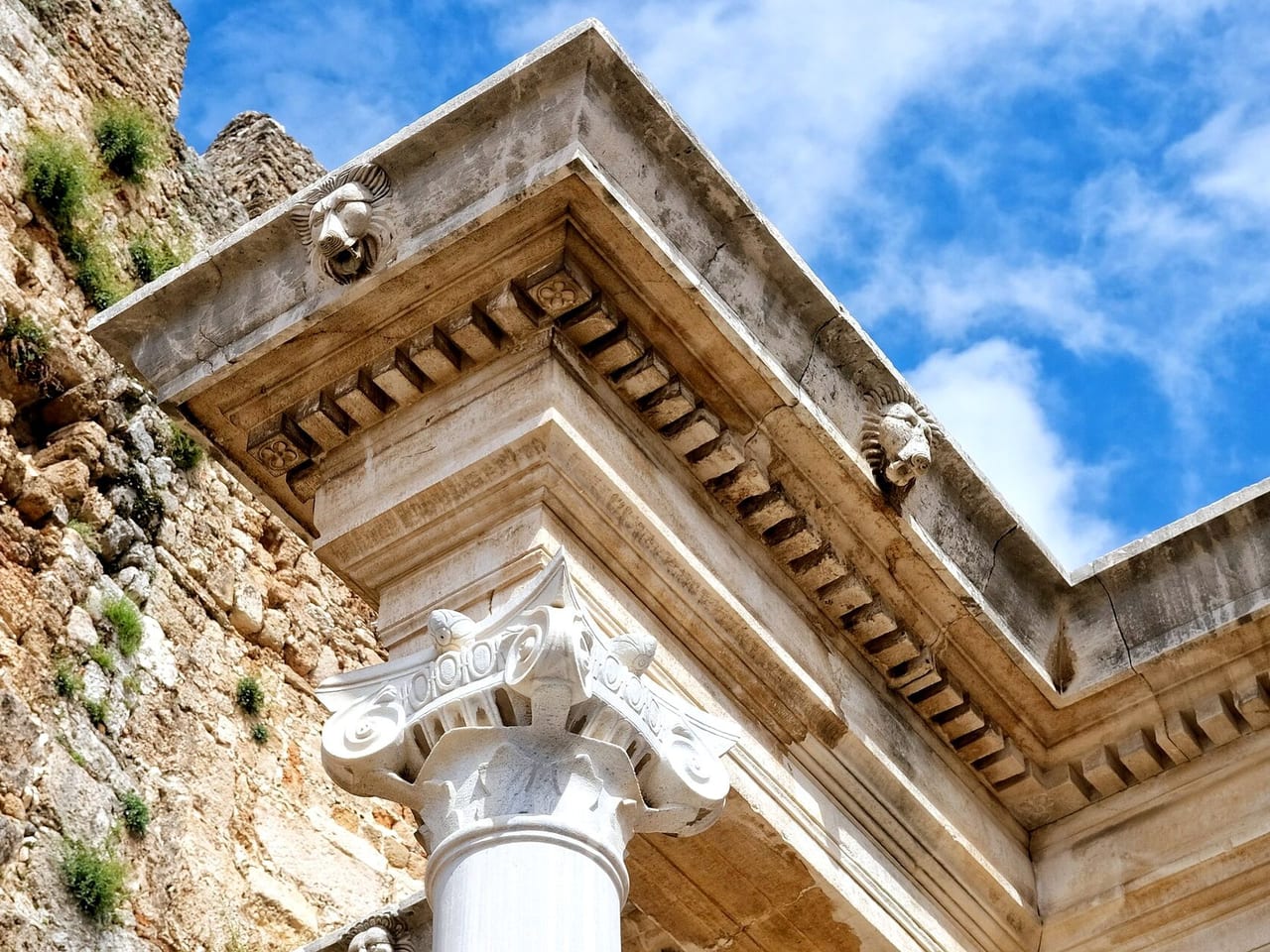
Hadrian's Gate
A triple-arched marble gate built in AD 130 to honor Emperor Hadrian's visit to the city; for centuries it lay hidden behind the walls.
The emperor's gate
Hadrian's Gate was built to honor Emperor Hadrian's visit to Attaleia in AD 130. It stands mid-way along the eastern land wall, at one of the city's main entrances, where the roads to Perge, Aspendos, and Side began. Its purpose is debated: to some researchers it was purely for show, to others the main land gate of the wall circuit from the start. Locals call it Üçkapılar, the Three Gates; it is also known as the Gate of Hadrianus. Apart from its columns, it is of white marble, with carved and relief decoration. It once had two stories; the upper one is lost. Its architrave carried a bronze-lettered inscription dedicated to Hadrian.
The gate behind the walls
Walls later raised in front of and behind it hid the gate for a long time. It reappeared in 1882, when the remains of the walls were pulled down, and was later restored. Its flanking towers are not of the same date. The southern one was paid for by Julia Sancta from her own funds in Hadrian's time; she also set up a statue of the emperor's sister, Paulina. The northern tower is ancient below and Seljuk above; an inscription in its upper part records a Seljuk repair of 1220.
Where
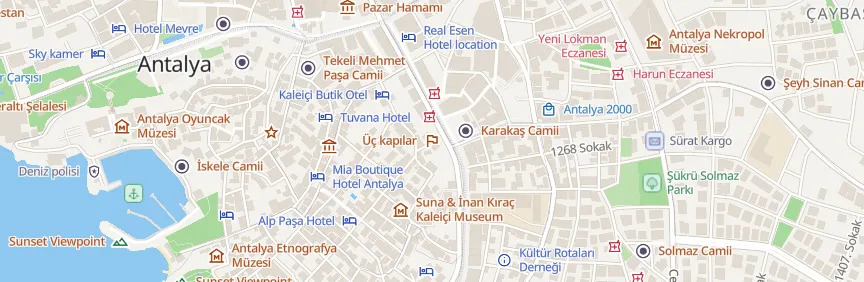
Nearby places
 Inner Wall and Conquest Inscriptions

Routes that include this place
Listen as you walk
Guide & Travel starts the story by itself when you reach the place, and it works offline too.
Photos (5)
- Inner Wall and Conquest Inscriptions — Photo: Intermerker · CC BY-SA 4.0 · Wikimedia Commons (cropped)
- City Walls — Photo: Intermerker · CC BY-SA 4.0 · Wikimedia Commons (cropped)
- İmaret Madrasa — Photo: Intermerker · CC BY-SA 4.0 · Wikimedia Commons (cropped)
- Kaleiçi Houses — Photo: Intermerker · CC BY-SA 4.0 · Wikimedia Commons (cropped)
- Upper Düden Waterfall — Photo: zolakoma · CC BY 2.0 · Wikimedia Commons (cropped)
