King's Tomb
A Lycian sarcophagus of the 4th century BC, seen as the symbol of Kaş: lion heads and human reliefs on its lid, and an eight-line poetic Lycian inscription on its tomb chamber that cannot be read.
A sarcophagus with an unread inscription
At the end of Uzun Çarşı, the long market street of eastern Kaş, rises this monumental Lycian sarcophagus, seen as the symbol of the town and dated to the 4th century BC. Made of local limestone, it has four parts: a two-stepped base, a tomb chamber (hyposorion), a second base cut from a single block, and the sarcophagus chest with its lid. On the south-facing long side of the chamber is an eight-line Lycian inscription that reads like a poem rather than an ordinary epitaph. Because it cannot be read, no one knows whom the tomb belonged to, so local people called it the "King's Tomb." Lion-head projections on the lid's long sides served to lift it; its pointed pediments recall a Gothic arch. The northwest pediment shows a half-clothed man leaning on a staff, a cloaked woman seated opposite him, and a dog turning its head toward the man. On the southeast pediment a cloaked woman stands facing a badly damaged male figure. Nineteenth-century travelers found the sarcophagus remarkable for its form, proportions, and setting; Charles Fellows drew it and copied its inscription, and Thomas Spratt dated it, by its architecture and inscription, to the same period as the city's rock tombs.
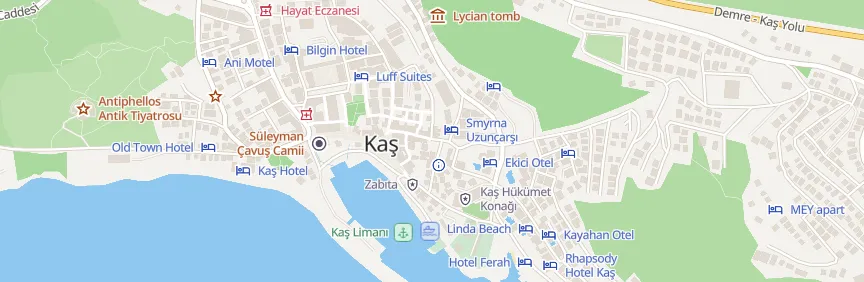
Where
Nearby places
 Rock Tombs

Listen as you walk
Guide & Travel starts the story by itself when you reach the place, and it works offline too.
Photos (4)
- Rock Tombs — Photo: Alexkom000 · CC BY 4.0 · Wikimedia Commons (edited)
- Temple — Photo: Alexkom000 · CC BY 4.0 · Wikimedia Commons (edited)
- Rock-Cut Doric Tomb — Photo: Alexkom000 · CC BY 4.0 · Wikimedia Commons (edited)
- Theater of Antiphellos — Photo: Alexkom000 · CC BY 4.0 · Wikimedia Commons (edited)